
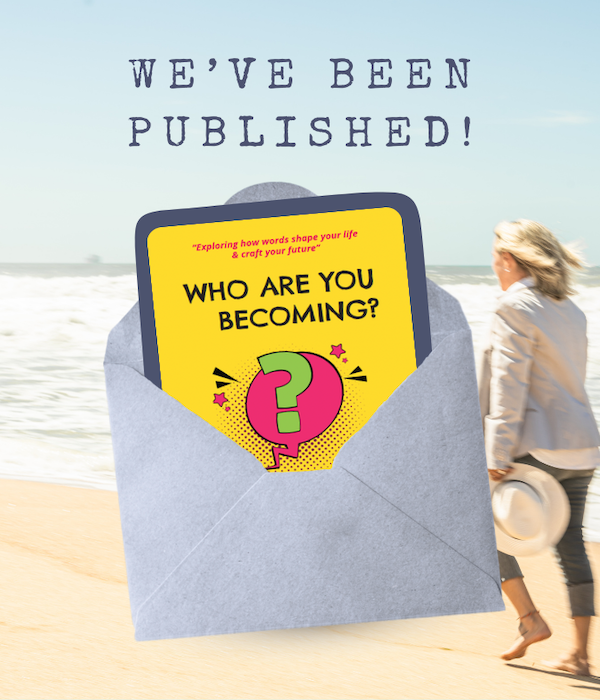
Confession: I still can’t quite believe I get to type these words… my book is PUBLISHED. After a long time (okay, honestly — years) of scribbling notes, revising sentences so many times I often questioned my sanity, and drinking far too much coffee (and a touch of wine 🙂), my book Who Are You Becoming is officially out in the world.
This isn’t a tick on my bucket list — it’s a dream poured out onto paper, bound together by a strong belief in the topic which is now alive on Amazon (yes, I’ve already checked, more than once).
Behind the title
At its heart, Who Are You Becoming is a book about the power of words — the ones we speak to ourselves, the ones we speak to others, and the ones leaders speak that ripple out into culture and across companies. I’ve learned (sometimes the hard way) that words aren’t just sounds. They carry energy. They craft the stories we live in. They shape who we are — and who we’re becoming.
We often think of words as mere symbols or sounds used to transfer meaning from one human to another. Yet science and lived experience tell us that words are far more powerful than that. Words are vibrations. They carry frequencies. And they have the power to shape our lives, our relationships, and even our cultures.
This book is certainly not a lecture from an expert; it’s an exploration — a curious wander down the rabbit hole, shared from one human to another. It invites you to pause for a moment and notice the language you use every day — the casual, habitual words that slip out in conversation, the phrases you lean on and repeat without thinking, the stories you tell about yourself and the world around you. Because hidden in those words are the clues to your future self.
The frequency factor
Physics teaches us that everything in the universe vibrates. Atoms oscillate. Strings (in string theory) resonate. Every material object and living being has a natural frequency at which it operates. When two things share the same frequency, resonance amplifies their effect.
- Everything vibrates: in physics, every atom and molecule oscillates at a frequency. This is the foundation of resonance and quantum theory.
- Frequency = Energy: higher frequencies carry higher energy (though not measured in the same way as sound waves or light, it’s the principle that “vibration = force of impact”).
- Resonance: when two systems share a frequency, they amplify each other. This is why an opera singer can shatter glass — her vocal vibration resonates with the glass’s natural frequency.
The principle is simple: frequency carries energy, and resonance multiplies it.
The echo of our words
When we speak, we create sound waves — literal vibrations traveling through the air. However, the power of words goes beyond acoustics:
- Physically, our bodies respond to words. Tone, pitch, and cadence affect heart rate, breathing, and brain activity.
- Emotionally, words trigger feelings that shift our state of being, either uplifting us or weighing us down.
- Collectively, words ripple across groups, influencing shared moods, cultures, and decisions.
The vibration of a word is not only in its sound but in its meaning. “Love,” “trust,” and “possibility” vibrate differently in our bodies and minds than “fear,” “failure,” or “hate.”
- Words are sound waves: spoken words are literally vibrations traveling through the air, carrying energy.
- Biological resonance: our nervous system, brain waves, and even heart rhythms respond to these frequencies. Calming words spoken slowly resonate differently in our bodies than harsh words spoken sharply.
- Psychological frequency: words trigger emotions (joy, fear, hope) which shift our “state” — like tuning our personal instrument.
- High-frequency words: words like trust, love, gratitude, possibility resonate at a “higher vibration” — they energize, uplift, and build connection.
- Low-frequency words: words like hate, failure, hopeless carry “heavier” vibrations — they drain, erode trust, and create dissonance.
- Collective resonance: in organisations, the “frequency” of leaders’ language shapes culture. A consistent pattern of high-vibration words creates momentum, loyalty, and energy. Low-vibration words create disengagement, fear, and silence.
Two broad categories
- High-frequency words – inspire, energize, uplift. Words of gratitude, kindness, vision, and possibility set people into resonance with hope and creativity.
- Low-frequency words – drain, diminish, destabilize. Words of criticism, blame, or despair create dissonance, weakening trust and eroding connection.
The words we use most often set the frequency at which we live. Over time, our language habits shape our mindset, our experience of reality, our relationships, and the futures we are co-creating.
The story your words are telling
Curious how something as small as a phrase could set a new direction for your life?
Which of these resonates with you (be super honest with yourself, no one is watching 😉):
- “What would make me stronger?” v. “What would make me more likable?”
- “What matters to me?” v. “What will impress them?”
- “What feels authentic?” v. “What feels acceptable?”
- “What do I truly need?” v. “What do they expect of me?”
- “What will bring me peace?” v. “What will keep me busy?”
- “What’s aligned with my values?” v. “What will keep me popular?”
- “What choice leads to growth?” v. “What choice avoids conflict?”
- “What’s real?” v. “What’s easy?”
- “What requires courage?” v. “What feels familiar?”
Have you ever asked yourself?
Is everything I believe about right and wrong, success and failure, in fact, all my beliefs, did I actually choose them, or did I inherit this set of beliefs?
Becoming who you truly are begins with looking inward — questioning what you believe, shaping your own ideas about yourself and the world.
Many people never uncover who they actually are, because they spend their lives chasing who they think they should be — wearing masks, following someone else’s script, and building their identity on the shaky ground of others’ opinions.
Becoming who you were born to be begins with mastering your thoughts and words. It isn’t something that happens to you; it’s something you actively take control of. It’s an intentional act and the deliberate shaping of the story and life you were born to live. One chosen for you, by you.
The resonance of leadership
There’s a chapter in the book devoted to the words we use at work — a topic that could easily fill an entire book itself (and one day, it will 🙂). It’s a subject close to my heart, because leaders’ words have such a powerful impact on their people and organisational culture.
Leaders, in particular, broadcast at high volume. Their words ripple through teams, organizations, and markets. A leader who consistently uses high-vibration words creates alignment, momentum, and trust. One who leans on low-vibration words breeds fear, disengagement, and silence.
Consider the statements below. Which leader are you? Which one would you choose to work for? Which one do you work for?
- How can I support you?” v. “Why didn’t you get this done?
- What can we learn from this?” v. “Who’s to blame for this?
- Your perspective matters here.” v. “Let me tell you how it should be done.
- Let’s solve this together.” v.“ This isn’t my problem, it’s yours.
- I trust your judgment.” v.“ I’ll need to sign off on every step.
- It’s okay to fail — we’ll figure it out.” v. “Failure isn’t an option here.
- Thank you for the effort you’ve put in.” v. “This simply isn’t good enough.
- Here’s why this matters.” v. “Just do it because I said so.
You see, language isn’t just a tool for communication — it’s culture in motion. The tone and frequency of a leader’s words can set an organisation buzzing with possibility or circling in doubt.
More about this in the book.
Ready to grab your copy?
The most profound truth about the Law of Vibration is this: we can choose our frequency. We can choose the words we silently (sometimes loudly) speak to ourselves, to others, and into the world. This isn’t about being artificially positive or ignoring hard truths. It’s about intentional language — words that carry you toward the future you want, rather than habitual ones that trap you in yesterday’s story. By choosing words that align with your vision of the future, you stop reacting on autopilot, repeating the past, and wondering why nothing changes.
Every word is a vibration. Every vibration carries energy. And every choice of words is, quite literally, a choice of frequency — the frequency at which we live, lead, and become.
Back in 1925, Florence Scovel Shinn warned that anyone who failed to understand the power of their words was already behind the times. To me, it’s striking that a century later, in 2025, so many are still choosing to stay there.
You, on the other hand, are making different choices. You are courageously choosing to become the greatest version of yourself.
From my keyboard to your bookshelf
I’d love for you to read it. Pop over to Amazon, grab your copy of Who Are You Becoming, and step into the journey with me. And if it stirs something in you (as I sincerely believe it will 🙂), I’d be over the moon if you shared it with a friend or left a review.
After all, words create momentum — and I can’t wait to hear where yours are taking YOU.
Frequently Asked Questions
1. Do words really have power beyond communication?
Yes. Words are more than symbols — they carry energy, trigger emotions, and shape how we see ourselves and the world. Neuroscience shows that positive or negative language can alter brain activity, hormone levels, and even our physical responses.
2. How do the words I use with myself affect my life?
Self-talk sets the tone of your inner world. Repeated phrases like “I’m not good enough” wire the brain toward fear and limitation, while words like “I’m learning” or “I’m capable” foster resilience, confidence, and growth.
3. Can words influence relationships and culture?
Absolutely. Words are the building blocks of trust, connection, and belonging. Supportive, high-frequency words (“thank you,” “I believe in you”) strengthen relationships, while critical or dismissive language erodes connection and creates distance.
4. Why do some words feel ‘heavier’ or more draining than others?
Every word carries a kind of frequency. High-frequency words (like “gratitude,” “hope,” “trust”) energize and uplift, while low-frequency words (like “hate,” “failure,” “impossible”) create tension, stress, and dissonance. Over time, these vibrations shape mood, behavior, and culture.
5. How can I start choosing words more intentionally?
Begin with awareness. Notice the habitual words you use with yourself and others. Ask: Does this word open possibilities or shut them down? Does it build connection or weaken it? By shifting even small daily phrases, you change the “frequency” of your life and relationships.